

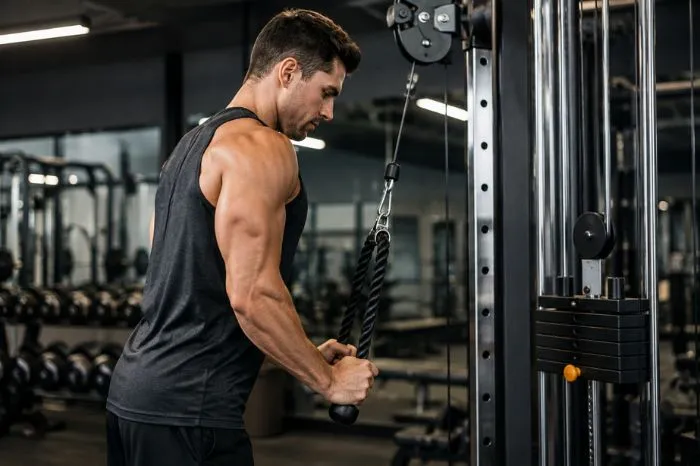
Cable tricep exercises make it easy to train your triceps through different arm positions while keeping resistance controlled and adjustable. You do not need a dozen nearly identical pushdown variations, either. A good cable tricep workout can be built around a few movements that complement one another.
For most people, a useful combination is a pushdown, an overhead cable extension and, when additional work is needed, a single-arm or cross-body variation. The pushdown gives you a simple and stable elbow-extension exercise, while the overhead position trains the triceps from a more lengthened position.
This guide covers eight useful cable tricep exercises, how to perform them, common mistakes to avoid, and practical ways to combine them into a workout.
Best Cable Tricep Exercises at a Glance
| Exercise | Best For | Suggested Reps | Difficulty |
|---|---|---|---|
| Rope Cable Tricep Pushdown | Beginners, controlled pushdowns and higher-rep work | 10–15 | Beginner |
| Straight-Bar or V-Bar Pushdown | Stable pushdowns and heavier loading | 8–12 | Beginner |
| Overhead Cable Tricep Extension | Training the triceps in a lengthened overhead position | 10–15 | Beginner–Intermediate |
| Single-Arm Overhead Cable Extension | Unilateral training and comfortable arm positioning | 10–15 per arm | Intermediate |
| Cross-Body Cable Tricep Extension | Unilateral control and a different cable angle | 10–15 per arm | Intermediate |
| Single-Arm Cable Pushdown | Side-to-side balance and simple technique | 10–15 per arm | Beginner |
| Lying Cable Tricep Extension | Lengthened-position training with a bench | 8–12 | Intermediate |
| Cable Tricep Kickback | Controlled finishing work | 12–20 per arm | Intermediate |
In short: If you only want three cable tricep exercises, start with a pushdown, an overhead cable extension and a unilateral movement such as a cross-body extension. This gives you a stable neutral-arm exercise, an overhead exercise and an easy way to train each side independently.
How Cable Exercises Train Your Triceps
The triceps brachii is the large muscle on the back of the upper arm. It consists of three heads: the long head, lateral head and medial head. All three contribute to straightening, or extending, the elbow.
The long head differs anatomically from the other two because it originates from the scapular region and crosses the shoulder joint. That makes shoulder position relevant when choosing triceps exercises. You can read more about the anatomy of the muscle in this NCBI overview of the triceps brachii.
Research comparing cable elbow extensions performed with the arm overhead versus in a neutral position found greater triceps hypertrophy after training in the overhead position, with a particularly notable difference in the long head. This does not mean pushdowns are ineffective. Instead, overhead extensions and pushdowns can complement one another within the same program. The study is available through PubMed.
It is also worth remembering that changing the handle or arm angle does not completely isolate one triceps head. All three heads contribute to elbow extension, although positioning can change their relative involvement and the length at which they are trained.
8 Best Cable Tricep Exercises
1. Rope Cable Tricep Pushdown
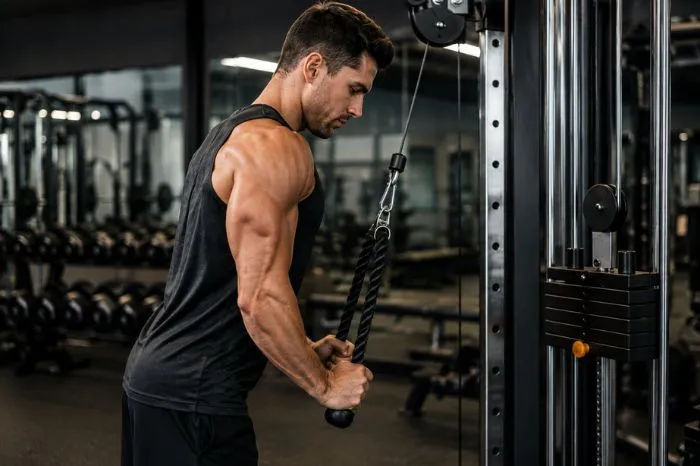
The rope pushdown is one of the simplest cable tricep exercises to learn. Its neutral grip can also feel more comfortable than a fixed straight bar for some lifters.
Suggested programming: 2 to 4 sets of 10 to 15 reps.
How to Do a Rope Cable Tricep Pushdown
- Attach a rope to a high cable pulley.
- Stand facing the machine with your feet around hip- to shoulder-width apart.
- Hold one end of the rope in each hand and keep your elbows close to your sides.
- Brace your torso and straighten your elbows to press the rope toward the floor.
- Reach controlled elbow extension without aggressively snapping the joint.
- Allow the rope ends to separate slightly if it feels natural.
- Slowly return the rope until your elbows are comfortably bent again.
Common Mistakes
- Using so much weight that the torso swings
- Allowing the elbows to travel substantially forward on every repetition
- Bending the wrists excessively
- Letting the weight stack slam between reps
- Forcing the rope apart instead of simply extending the elbows
2. Straight-Bar or V-Bar Cable Pushdown
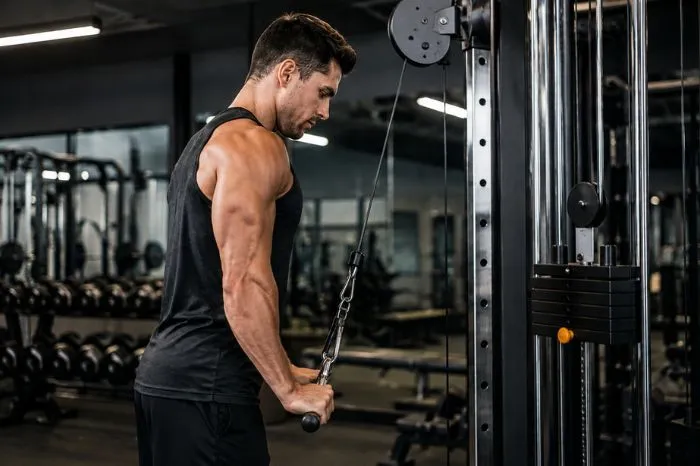
A fixed bar makes the pushdown feel stable and can make it easier to use somewhat heavier loads while maintaining a consistent path. A straight bar and V-bar do not need separate places in the same workout unless one clearly feels better for you.
Suggested programming: 2 to 4 sets of 8 to 12 reps.
How to Do a Bar Cable Pushdown
- Attach a straight bar or V-bar to a high pulley.
- Stand close enough to the machine that you can keep your torso stable.
- Hold the attachment firmly and position your elbows beside your torso.
- Extend your elbows and press the bar downward.
- Avoid turning the exercise into a chest or shoulder press.
- Straighten your arms under control.
- Slowly allow the bar to return to the starting position.
Common Mistakes
- Choosing a weight based on the number on the stack instead of usable form
- Rolling the shoulders forward
- Flaring the elbows excessively
- Cutting the range of motion short
- Using hip momentum to start the repetition
3. Overhead Cable Tricep Extension
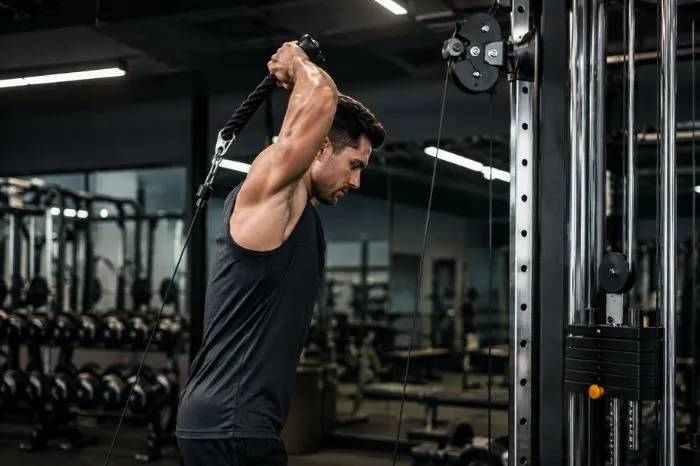
The overhead cable extension deserves a central place in a well-rounded cable tricep workout. Raising the arm overhead places the long head of the triceps in a more lengthened position.
A longitudinal study comparing overhead and neutral-arm cable elbow extensions found greater triceps growth in the overhead condition. This makes the exercise especially useful alongside a standard pushdown rather than simply replacing it.
Suggested programming: 2 to 4 sets of 10 to 15 reps.
How to Do an Overhead Cable Tricep Extension
- Attach a rope to a low cable pulley.
- Face away from the machine and bring the rope behind your head.
- Use a staggered or shoulder-width stance for balance.
- Keep your upper arms generally beside your head without forcing them into an uncomfortable position.
- Extend your elbows and move your hands forward and upward.
- Straighten your arms under control.
- Slowly bend your elbows to return to a comfortable stretched position.
Common Mistakes
- Using a load that pulls the torso backward
- Excessively arching the lower back
- Forcing the shoulders into an uncomfortable range
- Turning the exercise into a whole-body movement
- Rushing the return portion of the repetition
4. Single-Arm Overhead Cable Tricep Extension
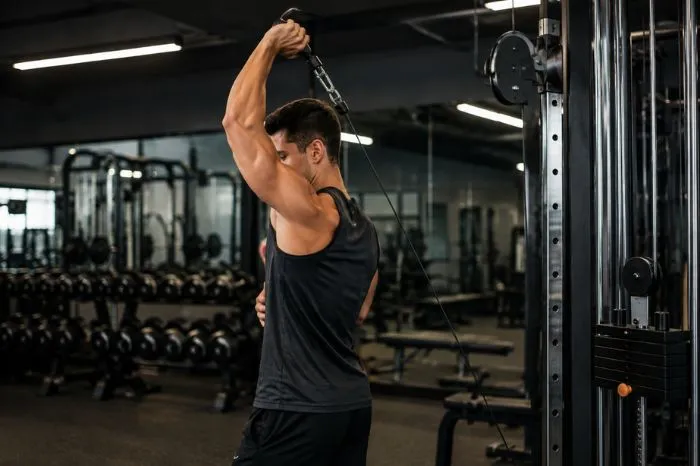
The single-arm version gives each side its own workload and allows you to find an elbow and shoulder position that feels natural for your anatomy.
Suggested programming: 2 to 3 sets of 10 to 15 reps per arm.
How to Do It
- Use a low pulley with a single handle, single rope or suitable cable attachment.
- Face away from the cable and position the working arm overhead.
- Brace your torso and keep the shoulder comfortable.
- Extend the elbow until the arm is straight.
- Keep the rest of your body relatively still.
- Return slowly into elbow flexion before starting the next repetition.
Common Mistakes
- Twisting the torso
- Using substantially different ranges of motion on each arm
- Allowing the cable to pull the shoulder into an uncomfortable position
- Choosing too much weight for a unilateral exercise
5. Cross-Body Cable Tricep Extension
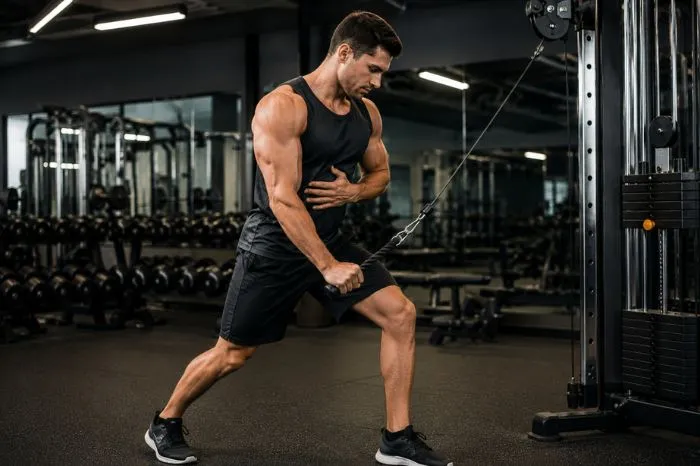
The cross-body extension is another useful unilateral option. It works particularly well when you want independent loading without placing both arms overhead at the same time.
Suggested programming: 2 to 3 sets of 10 to 15 reps per side.
How to Do It
- Set the cable around upper-chest to head height.
- Use a single handle or suitable cable end.
- Stand slightly across from the pulley so the cable runs diagonally toward the working arm.
- Stabilize your upper arm in a comfortable position.
- Extend the elbow across and slightly away from your body.
- Follow the natural line of the cable rather than forcing a perfectly vertical path.
- Control the return instead of allowing the stack to pull your arm back.
Common Mistakes
- Rotating the entire torso
- Turning the exercise into a shoulder movement
- Using a grip that irritates the wrist
- Racing through the lowering portion
6. Single-Arm Cable Pushdown

If bilateral pushdowns allow your stronger arm to dominate, a single-arm pushdown makes the work performed by each side easier to monitor. It can also be a useful alternative when fixed bars feel awkward on the wrists.
Suggested programming: 2 to 3 sets of 10 to 15 reps per arm.
How to Do It
- Attach a D-handle to a high pulley.
- Face the cable and brace your torso.
- Bring the working elbow near your side.
- Extend the elbow to press the handle toward the floor.
- Straighten the elbow smoothly.
- Control the return before performing the next repetition.
Common Mistakes
- Leaning sideways
- Shrugging the working shoulder
- Changing technique between the left and right sides
- Increasing the load before the weaker side can control the current weight
7. Lying Cable Tricep Extension
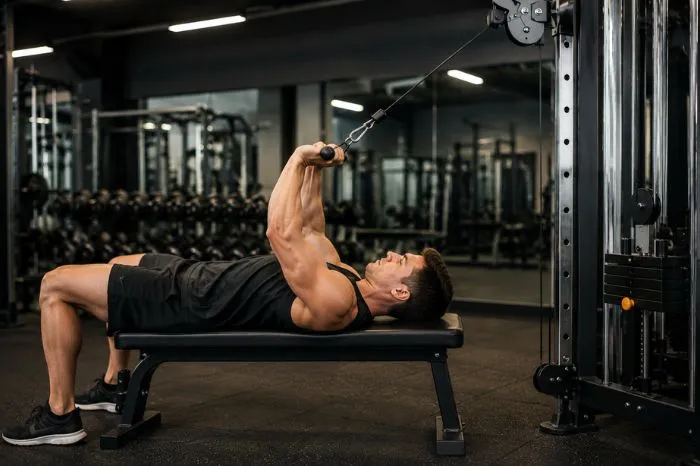
A lying cable extension requires a bench but offers another way to train elbow extension with the upper arm positioned differently from a standard pushdown.
Suggested programming: 2 to 3 sets of 8 to 12 reps.
How to Do It
- Place a bench near a low cable pulley.
- Attach an EZ-style bar or another attachment that gives you a comfortable grip.
- Lie on the bench and take hold of the attachment.
- Position yourself so the cable remains under useful tension through the movement.
- Bend and extend the elbows through a comfortable range.
- Control the cable throughout the movement.
- Extend the elbows smoothly before lowering the attachment again.
Common Mistakes
- Setting the bench so far from the pulley that the setup becomes awkward
- Using too much weight before learning the cable path
- Dropping quickly into the bottom position
- Forcing the elbows or shoulders into an uncomfortable range
8. Cable Tricep Kickback
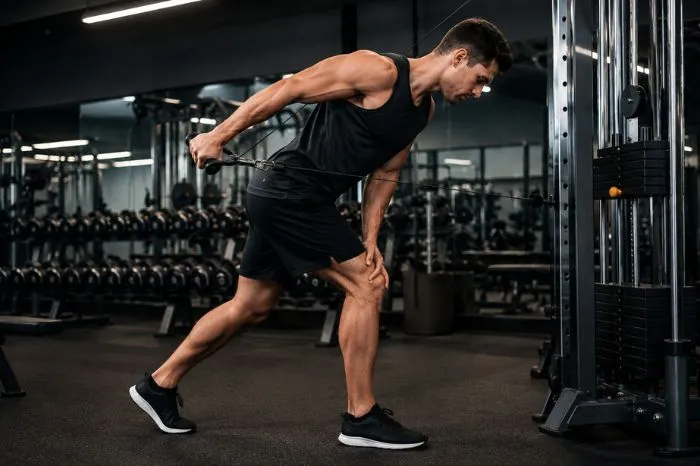
A cable kickback can work well as lighter finishing work because the cable provides resistance as you extend the elbow. However, it should not be treated as automatically better than overhead extensions simply because an acute muscle-activation study showed high triceps activity during a kickback variation.
The American Council on Exercise study measured acute muscle activation. It did not prove that one exercise necessarily produces greater long-term muscle growth than another.
Suggested programming: 2 to 3 sets of 12 to 20 reps per arm.
How to Do It
- Set the pulley around hip height or slightly lower.
- Hold a single attachment or suitable cable end.
- Hinge forward at the hips while keeping your torso stable.
- Position the working upper arm beside or slightly behind your torso.
- Extend the elbow to move the hand backward.
- Reach controlled elbow extension.
- Allow the elbow to bend again without swinging the shoulder.
Common Mistakes
- Swinging the arm instead of extending the elbow
- Dropping the elbow as fatigue increases
- Using a load that requires torso rotation
- Using momentum for the final repetitions
Three Cable Tricep Workouts You Can Actually Use
You do not need to perform all eight exercises in one session. For most people, that would simply create unnecessary overlap between similar movements.
Beginner Cable Tricep Workout
| Exercise | Sets | Reps | Rest |
|---|---|---|---|
| Rope Cable Pushdown | 2–3 | 10–15 | 60–90 seconds |
| Overhead Cable Extension | 2 | 10–15 | 60–90 seconds |
Beginners should focus on learning the exercises before deliberately pushing every set to exhaustion. Start by finishing most sets while you could still perform around two or three good repetitions.
Muscle-Building Cable Tricep Workout
| Exercise | Sets | Reps | Rest |
|---|---|---|---|
| Straight-Bar or V-Bar Pushdown | 3 | 8–12 | 75–120 seconds |
| Overhead Cable Tricep Extension | 3 | 10–15 | 75–120 seconds |
| Cross-Body Cable Extension | 2 | 12–15 per arm | 60–90 seconds |
Most working sets can finish within roughly one to three repetitions of technical failure, provided your form remains controlled.
10-Minute Cable Tricep Workout
| Exercise | Sets | Reps | Rest |
|---|---|---|---|
| Rope Cable Pushdown | 2 | 10–15 | 60 seconds |
| Overhead Cable Extension | 2 | 10–15 | 60 seconds |
A short workout does not need complicated intensity techniques. Four well-controlled working sets can be more useful than rushing through numerous nearly identical exercises.
How Many Sets and Reps Should You Do for Triceps?
There is no single number that suits every lifter. The right amount of direct triceps work depends on your training experience, exercise selection, effort, recovery and how much pressing you already perform for your chest and shoulders.
The American College of Sports Medicine’s resistance-training position stand reports that muscle growth generally benefits from greater weekly training volume and discusses approximately 10 weekly sets per muscle group as useful broad context for hypertrophy. This should not be interpreted as a rigid prescription for everyone.
Chest presses, overhead presses and push-ups also involve the triceps. Someone performing substantial pressing may therefore require fewer direct cable sets than someone whose program contains very little pressing.
This is especially important when planning a push day workout, where chest and shoulder presses already contribute meaningful triceps work.
For a newer lifter, beginning with around four to six direct triceps sets across the week can be a reasonable starting point. More experienced trainees can gradually add work when progress, performance and recovery indicate that additional volume is useful.
Do You Need to Train Triceps to Failure?
No. You do not need to take every cable tricep set to complete muscular failure.
Training reasonably close to failure can make a set challenging enough to stimulate adaptation, but repeatedly continuing until you physically cannot complete another repetition is not required for building muscle. Current resistance-training guidance does not show a consistent need for momentary muscular failure in healthy adults.
A useful practical approach is to stop many working sets when you believe you could perform around one to three additional good repetitions. Beginners can remain slightly farther from failure while learning technique.
Technical failure also matters. If another repetition requires you to swing your torso, dramatically change your shoulder position or shorten your normal range of motion, the quality of the set has already started to decline.
How to Progress Your Cable Tricep Exercises
Progressive training does not mean making every workout brutally harder than the one before it. The aim is to gradually improve what you can perform while maintaining the intended technique.
A simple progression method is:
- Choose a rep range, such as 10 to 15.
- Select a weight you can perform near the lower part of that range with good form.
- Gradually add repetitions over future sessions.
- Once you can reach the top of the range across your planned sets without changing technique, increase the cable stack by the smallest practical amount.
- Your repetitions may temporarily fall toward the bottom of the range again. Build them back up over time.
This gives you a clearer way to measure progress than simply trying to use the heaviest possible weight on the cable stack.
Rope vs Bar: Which Is Better for Tricep Pushdowns?
Neither attachment is universally better.
A rope allows a neutral hand position and lets each hand move independently near the bottom of the repetition. Some people find this more comfortable for their wrists.
A straight bar or V-bar provides a fixed and stable grip, which may make heavier pushdowns easier to control.
The attachment should not be chosen because somebody claims it completely isolates a particular triceps head. Choose the option that suits your wrists, elbows, available equipment and training goal while allowing consistent elbow-extension technique.
Common Cable Tricep Workout Mistakes
Doing Too Many Similar Pushdowns
A rope pushdown, straight-bar pushdown and V-bar pushdown are useful variations, but performing all three in the same workout does not automatically create a more complete triceps session. In many cases, one pushdown combined with an overhead exercise provides more meaningful variety.
Using Too Much Weight
If the load forces you to swing your body, repeatedly shrug your shoulders or turn the movement into a full-body press, reduce the weight and regain control of the exercise.
Trying to Completely Isolate One Triceps Head
The long, lateral and medial heads work together during elbow extension. Shoulder and arm position can change muscle length and emphasis, particularly for the long head, but this should not be confused with completely isolating one head from the others.
Ignoring Your Pressing Volume
Your triceps also contribute to chest presses, overhead presses and other pushing exercises. Consider your entire training week before deciding how many additional direct triceps sets you need.
Taking Every Set to Failure
More exhaustion does not automatically mean more productive training. Keep repetitions controlled and use proximity to failure strategically rather than making complete muscular exhaustion the goal of every set.
Changing Exercises Every Week
If you change the attachment, exercise, weight, rep target and technique every week, it becomes difficult to determine whether you are actually progressing. Keep a few useful exercises in your routine long enough to improve at them.
Ignoring Pain
Muscular effort and fatigue are expected during resistance training, but sharp or worsening pain should not be treated as evidence that an exercise is working. Stop a movement if it causes concerning pain and seek appropriate professional guidance if the problem persists.
Are Cables Better Than Dumbbells or Bodyweight Exercises for Triceps?
Not automatically. Cables, free weights and bodyweight movements are simply different ways of providing resistance.
Cables make it easy to adjust the direction of resistance, perform unilateral exercises and change the load in relatively small increments. Dumbbells and barbells offer their own advantages, while bodyweight movements can also train the triceps effectively.
For example, diamond push-ups are a useful bodyweight alternative that places substantial demand on the triceps while also involving the chest and shoulders. They can be particularly useful when you do not have access to a cable machine or want to combine cable and bodyweight exercises within the same training program.
The more useful question is not, “Which equipment is always best?” but, “Which exercise allows me to train the intended movement effectively, progressively and comfortably?” A well-designed program can combine cable exercises with free-weight or bodyweight movements rather than relying exclusively on one training method.
Final Takeaway
You do not need an enormous menu of cable tricep exercises to build a useful workout. Start with movements that provide genuinely different training positions.
For most lifters, this means combining a controlled pushdown with an overhead cable extension and adding a unilateral exercise when the additional work serves a purpose. Use a load you can control, progress gradually, account for the pressing work already included in your program and avoid turning exhaustion into the goal of every working set.
Most importantly, think of the long, lateral and medial heads as parts of one working triceps muscle rather than three muscles that can be completely isolated with different cable attachments. Good exercise selection is about creating useful differences in position, resistance and practicality, not collecting as many pushdown variations as possible.
Frequently Asked Questions About Cable Tricep Workouts
A useful cable tricep routine can be built around a pushdown, an overhead cable extension and a unilateral variation such as a cross-body extension. Other useful options include single-arm pushdowns, lying cable extensions and cable kickbacks. The best selection depends on your comfort, equipment and overall training program.
Yes. Cable exercises provide adjustable resistance and make it easy to perform several effective elbow-extension movements. Muscle growth still depends on adequate training effort, appropriate weekly volume, progression, nutrition and recovery rather than the cable machine itself.
All three heads of the triceps participate in elbow extension, but overhead cable extensions are particularly useful when you want to train the long head in a more lengthened position. Research comparing overhead and neutral-arm cable extensions found greater long-head and overall triceps hypertrophy in the overhead condition.
Not for every purpose. Overhead extensions train the triceps from a more lengthened position, while pushdowns are simple, stable and easy to load. Rather than choosing one permanently, many programs benefit from combining one overhead variation with one pushdown variation.
Use whichever attachment gives you comfortable wrists and elbows while allowing consistent technique. A rope offers independent hand movement and a neutral grip, while a fixed bar provides greater stability. Neither attachment is universally superior.
For most people, two or three direct triceps exercises are enough for one session. A practical combination is one pushdown, one overhead extension and, when additional volume is appropriate, one unilateral or finishing movement.
Your ideal number depends on training experience and how much pressing you already perform. Newer lifters can begin with a modest number of direct sets and add volume when needed. Current resistance-training guidance indicates that greater weekly training volume can support hypertrophy, with roughly 10 weekly sets per muscle group serving as useful general context rather than a universal requirement.
Training frequency should fit your total weekly volume and recovery. Many people train the triceps more than once each week because chest and shoulder pressing exercises already involve them. There is no requirement to perform a dedicated tricep workout every time the muscle is trained.
You do not need to take every set to complete failure. Many productive working sets can finish with a small number of good repetitions still possible. Getting reasonably close to failure while preserving technique is generally more practical than deliberately exhausting yourself on every set.
Yes. A cable machine can provide enough exercise variety and progressive resistance to train the triceps effectively. However, there is no requirement to use cables exclusively. Free-weight and bodyweight exercises can also contribute to triceps development.
Diamond push-ups can be an effective bodyweight option for training the triceps, but they do not need to replace cable exercises completely. Cable machines make resistance easier to adjust and provide several exercise angles, while diamond push-ups require little equipment and also involve the chest and shoulders. Using both can provide useful variety depending on your training setup.
A small amount of shoulder stabilization is normal, but excessive shoulder movement may indicate that the load is too heavy or that you are turning the pushdown into a compound pressing movement. Reduce the weight and focus on controlled elbow extension. If a movement causes persistent pain rather than normal muscular effort, stop and have the problem appropriately assessed.
You can straighten your elbows under control at the end of a repetition. Avoid aggressively snapping or forcing the joint into lockout. The goal is controlled elbow extension rather than generating momentum at the bottom of the movement.